Mornington Crescent, anyone?

Re: Mornington Crescent, anyone?
Probably a long shot as I can't establish when he died from any of the books I have here, but you're not by any chance Major Edward Halford of HRG are you?
J
"Home is where you park it", so the saying goes. That may yet come true..
"Home is where you park it", so the saying goes. That may yet come true..

Re: Mornington Crescent, anyone?
No, not he I'm afraid.JPB wrote:Probably a long shot as I can't establish when he died from any of the books I have here, but you're not by any chance Major Edward Halford of HRG are you?
Another clue? The name of the marque is nothing to do with my name, but does have a connection to ancient horses.....
Some people are like Slinkies - they serve no useful purpose, but they still bring a smile to your face when you push them downstairs.
Re: Mornington Crescent, anyone?
Hmm.  Gregory J Hippopotamus? This is as cryptic as the very worst of my efforts, good stuff!
Gregory J Hippopotamus? This is as cryptic as the very worst of my efforts, good stuff! J
"Home is where you park it", so the saying goes. That may yet come true..
"Home is where you park it", so the saying goes. That may yet come true..
Re: Mornington Crescent, anyone?
Yes! Damn! How did you get that?JPB wrote:Hmm.
Only joking - keep trying! There is a Wikipedia article about my company, so I'm not making this up.....
Some people are like Slinkies - they serve no useful purpose, but they still bring a smile to your face when you push them downstairs.
Re: Mornington Crescent, anyone?
Leslie Hayward Hounsfield, 1877 - 1957, Trojan Cars?
Re: Mornington Crescent, anyone?
Dammit man, you're good!arceye wrote:Leslie Hayward Hounsfield, 1877 - 1957, Trojan Cars?
Yes indeed, I am he.
From Wikipedia:
Trojan was founded by Leslie Hayward Hounsfield (1877–1957)[1] who went into business as a general engineer in a small workshop called the Polygon Engineering Works in Clapham, South London. He got the idea to make a simple, economical car that would be easy to drive and started design work in 1910.
In 1913 the prototype was ready. It had a two-stroke engine with four cylinders arranged in pairs, and each pair shared a common combustion chamber - a doubled-up version of what would later be called the "split-single" engine. The pistons in each pair drove the crankshaft together as they were coupled to it by a V-shaped connecting rod. For this arrangement to work, it is necessary for the connecting rod to flex slightly, which goes completely against normal practice. The claim was that each engine had only seven moving parts, four pistons, two connecting rods and a crankshaft. This was connected to a two-speed epicyclic gearbox, to simplify gear changing, and a chain to the rear wheels. Solid tyres were used, even though these were antiquated for car use, to prevent punctures and very long springs used to give some comfort.
Before production could start war broke out and from 1914 to 1918, Trojan Ltd, as the company had become in 1914, made production tools and gauges. In 1920 the first series of six cars were made from a works in Croydon and the final production version was shown at the 1922 London Motor Show. An agreement was reached with Leyland Motors to produce the cars at their Kingston upon Thames factory where work on reconditioning ex RAF wartime trucks was running down. This arrangement would continue until 1928 when Leyland wanted factory space for truck production. During the nearly seven years of the agreement 11,000 cars and 6700 vans were made
There are some Trojan cars in the local club I'm a member of, that's what made me think of it.
So that mean kind sir, that you are IT.
Cheers!
Some people are like Slinkies - they serve no useful purpose, but they still bring a smile to your face when you push them downstairs.
Re: Mornington Crescent, anyone?
Arceye for f'kin Prime Minister!
What threw me was that I was searching for an obscure maker that nobody would ever have heard of. There's a fleet of Trojan ice cream vans that ply their trade along the coast by here and have been doing so every summer since whenever it was that these things were built. Most have modern compressors, at least one is a tender without its own engine and a couple are powered by modern Diesels too so in that cases it's only the bodies that are of the period but Trojan is still very much represented in 2013. Oh, and their condoms are apparently pretty good also.
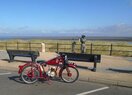
Here's a picture that combines my interest in old motors with my current fascination with Lomography:

What threw me was that I was searching for an obscure maker that nobody would ever have heard of. There's a fleet of Trojan ice cream vans that ply their trade along the coast by here and have been doing so every summer since whenever it was that these things were built. Most have modern compressors, at least one is a tender without its own engine and a couple are powered by modern Diesels too so in that cases it's only the bodies that are of the period but Trojan is still very much represented in 2013. Oh, and their condoms are apparently pretty good also.
Here's a picture that combines my interest in old motors with my current fascination with Lomography:
J
"Home is where you park it", so the saying goes. That may yet come true..
"Home is where you park it", so the saying goes. That may yet come true..
Re: Mornington Crescent, anyone?
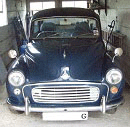
Ok then, I shall be B
British
Male
Dead
Re: Mornington Crescent, anyone?
Hello B,
Have you died within the last 113 years
Have you died within the last 113 years
Understeer: when you hit the wall with the front of the car.
Oversteer: when you hit the wall with the back of the car.
Horsepower: how fast you hit the wall.
Torque: how far you take the wall with you.
Oversteer: when you hit the wall with the back of the car.
Horsepower: how fast you hit the wall.
Torque: how far you take the wall with you.